
Louise Bennett is a registered acupuncturist (AHPRA) and member of AACMA, with a clinical background spanning over 35 years as a registered nurse and midwife. Medibank and Bupa recognised. WorkCover accepted.
Gentle and Balanced Healing
If you’re looking for an acupuncturist in Brisbane, it’s often because something hasn’t been fully resolving. Pain that keeps returning. Sleep that doesn’t restore you. Stress that stays at a level that’s become hard to ignore.
In clinic, these are the most common presentations. Treatment starts with understanding how these patterns have developed — and how your body is currently responding — rather than applying a fixed protocol from the outset.
How Acupuncture Works in Practice
Acupuncture uses fine, sterile needles placed at specific points on the body. The points selected depend on how your symptoms are presenting and how your system is functioning overall — not a one-size-fits-all approach.
From a clinical perspective, treatment is typically aimed at:
- Settling an overactive nervous system
- Improving circulation to affected areas
- Reducing muscle tension and irritability
- Supporting hormonal and regulatory processes
In many cases, the goal is not just symptom relief, but addressing the patterns that tend to keep symptoms returning.
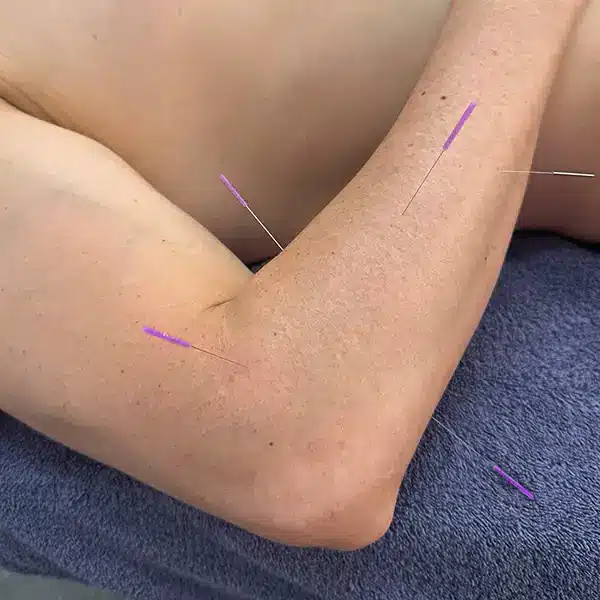
Acupuncture for tennis elbow
Conditions Commonly Treated
Over time, certain presentations come up repeatedly. These are some of the more common reasons people seek treatment.
Pain & Musculoskeletal Conditions
Back pain, neck tension, shoulder tightness, and sciatica are among the most frequent reasons people seek treatment, particularly when symptoms have become persistent or haven’t responded consistently to other approaches.
Headaches & Migraines
Recurring headaches and migraines are often connected to a combination of tension, nervous system load, and circulation. Treatment is adjusted based on how each person’s pattern presents.
Stress & Anxiety
Many patients come in when stress has moved beyond feeling manageable — showing up as poor sleep, fatigue, or difficulty switching off. Acupuncture for stress and anxiety works primarily through nervous system regulation, which is often where the most noticeable shift is felt first.
Sleep Disturbances
Difficulty falling asleep, waking through the night, or not feeling rested despite adequate hours can reflect an underlying pattern that hasn’t been addressed directly.
Women’s Health & Hormonal Concerns
This is an area where Louise’s background as a registered midwife makes a real difference. Having worked in women’s health across decades of clinical practice, treatment is informed by a depth of understanding that goes beyond what acupuncture training alone provides.
Conditions commonly seen include:
- Hormonal imbalance and irregular cycles
- Fertility support, including IVF preparation and support between cycles
- Pregnancy care throughout all trimesters
- Labour preparation and acupuncture for induction
- Perimenopausal and menopausal symptoms
- Endometriosis and menstrual pain
Digestive & General Health Concerns
Digestive discomfort, low energy, and broader systemic symptoms are sometimes linked to patterns that benefit from a more coordinated treatment approach.

LifeWave Patches – Click the logo to learn more
Vitality - Reawaken inner vitality
How Treatment Is Structured
Each session builds on what has been observed in previous visits.
The initial appointment involves a detailed discussion of your symptoms, health history, and how the condition has developed over time. This helps identify patterns that may not be immediately obvious from symptoms alone.
From there, points are selected based on your individual presentation. Treatment is adjusted as your body responds — rather than following a set number of sessions or a fixed plan regardless of progress. In some cases, treatment may also include:
- Cupping for muscle tension
- Heat therapy (moxibustion) for circulation and support
- Gentle manual techniques where appropriate
Treatment is adjusted as your body responds, rather than following a fixed protocol.
What You May Notice
Responses to acupuncture vary, but certain patterns are common.
- Many people feel a sense of relaxation during or immediately after treatment
- Some notice a shift within the first session.
- Others experience more gradual change over several visits, which is typical when symptoms have been present for some time.
Where conditions are longstanding, improvement tends to build progressively rather than arriving all at once.

Working Alongside Your Existing Care
Acupuncture is often used alongside other forms of treatment.
Many patients are already seeing a GP, physiotherapist, obstetrician, or fertility specialist. Where appropriate, treatment can be coordinated to support what you’re already doing, not replace it. If you’re going through IVF, for example, acupuncture is often used to support the body between cycles rather than as a standalone approach.
If you have questions about how acupuncture fits with your current care, that’s worth discussing at the first appointment.
About the Practitioner
Louise Bennett has been in clinical practice for over 35 years — first as a registered nurse and midwife, and now as a registered acupuncturist with a focus on complex and chronic presentations.
That nursing and midwifery background shapes how treatment is approached. It means conditions are assessed with an understanding of how the body works systemically, not just through the lens of a single symptom or modality. Many patients come in after trying other approaches without full resolution. Treatment here is adjusted based on how each person responds, not applied from a standard template.
Louise is registered with AHPRA and is a member of AACMA (Australian Acupuncture and Chinese Medicine Association). Treatment is recognised by Medibank and Bupa, and WorkCover patients are welcome.
Why People Seek Treatment Here
Patients often come in looking for:
- A more considered approach to ongoing symptoms
- Treatment that is adjusted over time
- A calm, consistent clinical environment
- Experience with more complex or persistent conditions
The focus is on understanding what is happening in your case and working from there.
Safety and comfort
- Only single-use, sterile needles are used.
- Treatments are adapted for your comfort level.
- We’ll discuss any medications, medical history, and whether acupuncture is suitable alongside your current care.
- If you’ve tried dry needling elsewhere and are curious about acupuncture vs dry needling, I’ll explain the broader diagnostic framework and gentle techniques used in TCM practice.
Where muscle tension is a significant component, cupping therapy is often incorporated into the session — either alongside acupuncture or as a standalone treatment.
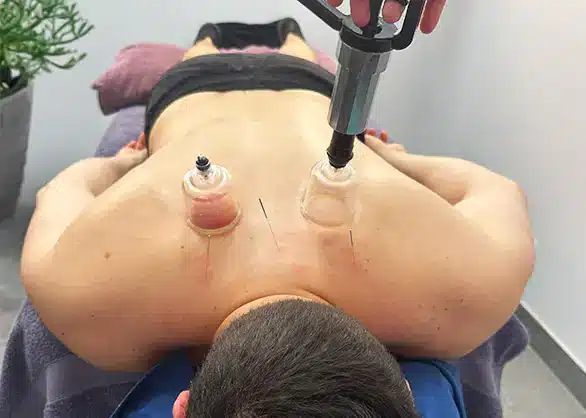
Brisbane acupuncture – cupping
Common Questions
Does acupuncture hurt?
Most people feel very little. Sensations during needling are usually mild and brief — often described as a dull ache, warmth, or heaviness at the point. This typically settles within seconds.
How many sessions will I need?
It depends on what you’re presenting with. Many people notice a change within the first few sessions. Longer-standing conditions generally respond better with a more consistent course of treatment over several weeks.
What should I expect after a session?
Many people feel relaxed immediately afterwards. Some notice gradual changes over the following day or two as the body responds. It’s worth noting how you feel in the 24–48 hours after treatment, as this often provides useful information for subsequent sessions.
Can acupuncture help with stress or anxiety?
Yes. It’s one of the more consistent areas of response in clinic. The primary mechanism is nervous system regulation, which often has a flow-on effect on sleep, tension, and general resilience.
Is acupuncture covered by private health insurance?
Treatment is recognised by Medibank and Bupa. Coverage depends on your specific policy and extras level — it’s worth checking directly with your fund.
Ready to Begin Treatment?
If something hasn’t been settling, treatment can begin with a clearer understanding of what’s contributing to it and how your body is responding.
Final Thoughts
If you’ve been considering acupuncture in Brisbane, I’d love to help you explore how this gentle therapy can support your health and wellness goals. Whether you need relief from pain, support during pregnancy, or help managing stress, we’ll work together to create a treatment plan that feels right for you.
References
- Vickers, A. J., Vertosick, E. A., Lewith, G., et al. (2018). Acupuncture for chronic pain: Update of an individual patient data meta-analysis. The Journal of Pain, 19(5), 455–474. https://doi.org/10.1016/j.jpain.2017.11.005
- MacPherson, H., Vertosick, E., Foster, N. E., et al. (2017). The persistence of the effects of acupuncture after a course of treatment: A meta-analysis of patients with chronic pain. Pain, 158(5), 784–793. https://doi.org/10.1097/j.pain.0000000000000747
- Smith, C. A., Armour, M., Lee, M. S., Wang, L. Q., & Hay, P. J. (2018). Acupuncture for depression. Cochrane Database of Systematic Reviews, (3), CD004046. https://doi.org/10.1002/14651858.CD004046.pub4
- Cardini, F., & Weixin, H. (1998). Moxibustion for correction of breech presentation: A randomized controlled trial. Journal of the American Medical Association (JAMA), 280(18), 1580–1584. https://doi.org/10.1001/jama.280.18.1580
- Yang, J., Zhou, X., Li, Y., et al. (2020). Effectiveness of acupuncture for migraine: A systematic review and meta-analysis. Journal of Headache and Pain, 21(1), 84. https://doi.org/10.1186/s10194-020-01164-7
- Australian Acupuncture and Chinese Medicine Association (AACMA). (2017). The Acupuncture Evidence Project: A Comparative Literature Review. https://acupuncture.org.au
- Smith, C. A., de Lacey, S., Chapman, M., Ratcliffe, J., Norman, R. J., Johnson, N. P. (2016). Effect of acupuncture vs sham acupuncture on live births among women undergoing in vitro fertilization: A randomized clinical trial. JAMA, 321(4), 337–345. https://doi.org/10.1001/jama.2018.17934
- Wu, C., Zheng, Y., Duan, Y., Lai, X., Xu, N., Tang, C., & Lu, L. (2019). Non-pharmacological interventions for cancer-related fatigue: A systematic review and Bayesian network meta-analysis. Worldviews on Evidence-Based Nursing, 16(2), 102–110. https://doi.org/10.1111/wvn.12352